The End of the Software Class System
In 1994, software built to fit your business was a luxury reserved for the largest companies on earth. AI just handed it to the corner machine shop. Software is coming home.
(…ahem…)
It's pronounced:
S - A - P

Oregon, 1994. A factory going up at dawn.
In 1994, I watched a sunrise from a construction site in Oregon — sky in purples and greys, the clang of steel, the bang-bang-bang of impact guns seating nuts on their spindles. I was hard-hatted and dirty, putting up steel to pay for college, the heavy tools on my belt slapping together like an industrial wind chime with every step. Behind me, the company we were building this factory for had just bought something called S-A-P. Software. One system to run everything: supply chain, production, billing.
The price was $65,000 per user — about $145,000 in today's dollars. Plus a year of disruption to deploy it. And for that money, you might think you'd earned the right to pronounce it as written. You hadn't. Say "Sap" and somebody winced and spelled it back at you.
Two thoughts stayed with me. The first was commercial: this is a successful company, and if they'll spend that much on software to manage processes they already run well, we aren't charging enough for steel. The second proved more durable: developers half a world away were about to dictate how an Oregon manufacturer ran its business. We were building them a factory to their exact specifications. The software that would run it came as-is. You could customize it, sure — for an additional price — but what that bought always looked less like a precise, durable part machined for the business than a hasty workaround bolted to the side. In the end, the business did the bending.
At that price, that was simply the deal. Software built to fit was for the giants. Everyone else bought off the shelf.
Fifty years of renting
Off the shelf won for a rational reason. Software was brutally expensive to build. Custom systems demanded big budgets, big teams, and long timelines, and they aged badly. So businesses bought packages, then rented them: SaaS turned a crushing capital expense into a manageable subscription. For half a century, the arithmetic favored renting over building.

The deal, for fifty years: their software, your bending.
But the terms of the lease were never neutral. The trade was control for convenience. You took what the vendor shipped, then reshaped your business around it. Your processes bent toward the vendor's assumptions. Your data — the accumulated record of how your company actually works — sat locked inside someone else's schema.
And the rent keeps rising. Gartner expects enterprise software spending to grow another 14.7% in 2026, past $1.4 trillion, while typical SaaS renewal increases now run around 8.7% a year — with hikes of 10 to 25% common. If your renewal quotes have started to read less like invoices and more like ransom notes, you are not imagining it.
The arithmetic flips
Here is what changed: AI has collapsed the cost of writing software. Google's CEO now says about 75% of the company's new code is AI-generated — a figure that stood at a quarter less than two years ago. Satya Nadella went further on the BG2 podcast. Asked about SaaS and business applications, he answered by naming Microsoft's own Dynamics — and said the notion that business applications exist is "probably where they'll all collapse ... in the agent era." When the man who sells more business software than anyone on earth says that about his own product line, it is worth sitting up.
I first heard this future described plainly in a conversation between Kevin Dewalt of Prolego and tech executive Tim Jones, who envisioned companies designing their own software in weeks, not years. That conversation has since become data. In Retool's 2026 build-vs-buy survey of 817 builders, 35% of teams had already replaced at least one SaaS tool with custom software, and 78% planned to build more this year. A small, senior team can now deliver in weeks what once required a systems integrator and a year.
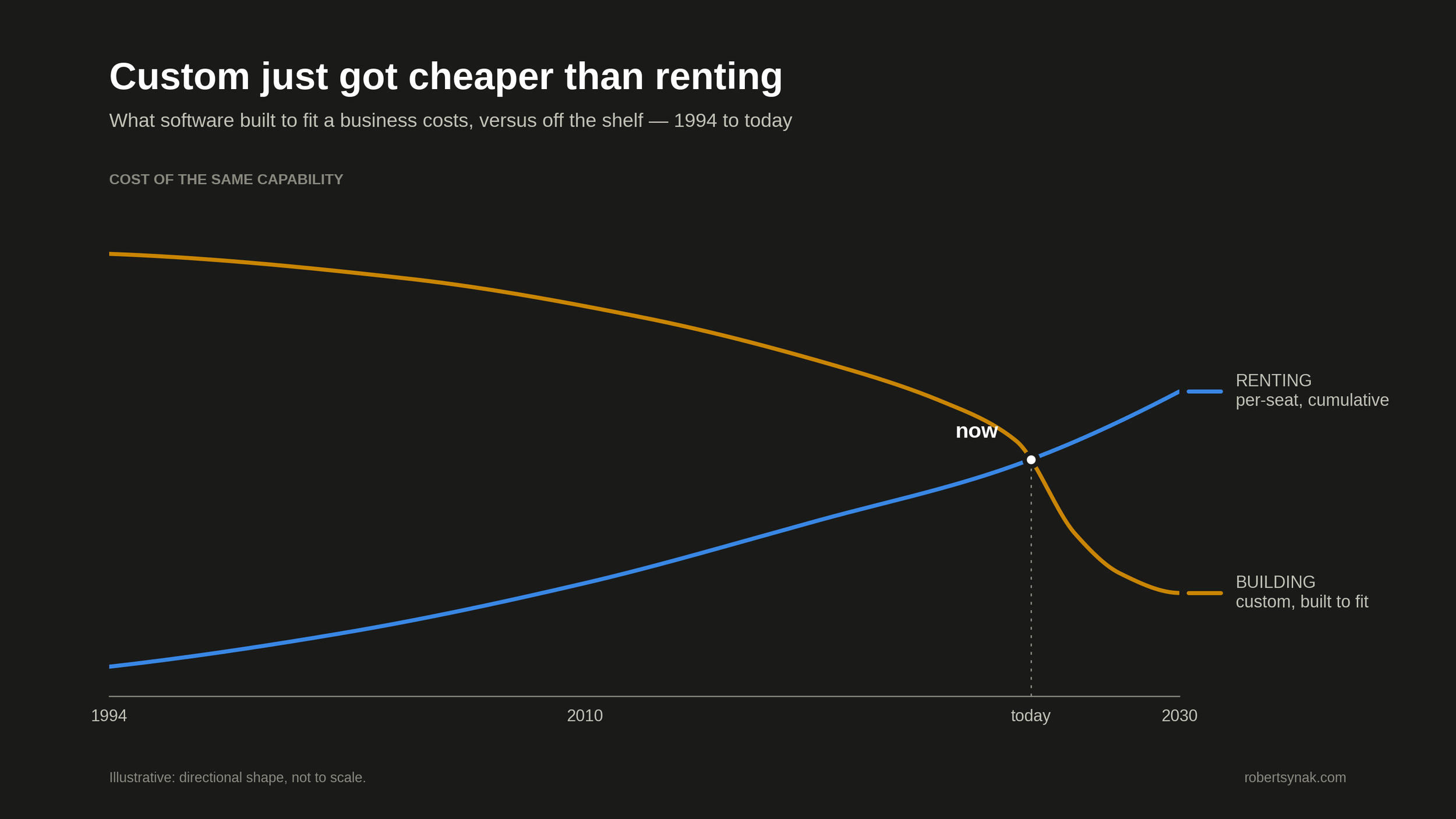
And surveys lag reality. By the time a third of teams will tell a pollster they've already switched, the migration has been underway for a while.
Step up, $2M - $1B …
…owner operators,
…ceos,
chief bottle washers…..
… it’s your turn
The commentary treats this as a story about tech giants and enterprise software budgets. The bigger change is happening further down the market, mostly unremarked.
Small businesses have adopted AI faster than almost any technology in memory: the U.S. Chamber of Commerce has tracked generative AI use climbing from 23% in 2023 to 40% in 2024 to 58% in 2025. But look at how they're using it. Nearly two-thirds rely mostly or entirely on externally developed tools — renting, again — and fewer than one in ten (8%) take what the Chamber calls a homegrown approach, building their own. Fifty years of experience taught that owning software is for other, larger people.
That lesson is a now stale anachronism. This is an opportunity.
For the first time since business software has existed, a $5 million company what only a $5 billion company could afford in 1994.: software shaped precisely to how it operates, that it owns outright. No per-seat rent that compounds like a bad mortgage. No feature roadmap decided in someone else's boardroom. Your pricing logic, your workflow, your customer relationships — encoded in an asset on your balance sheet instead of scattered across a dozen subscriptions.
A five-person machine shop next door to Intel, running ERP software built around its own way of working, is no longer a thought experiment. I've watched it happen. This is the quiet end of a fifty-year technology class system: the capability that defined enterprise advantage is now available to the companies that never had it.
What to build.
What to keep renting.
None of this means you should rebuild payroll. Commodity functions — accounting, HR, email — are solved problems, and renting them remains the right call. The build-versus-buy question has simply changed shape. It is no longer which vendor? It is what do we know about our business that no vendor could?
That knowledge — your pricing judgment, your operating rhythm, the way you decide what work to take and what to walk away from — is exactly what off-the-shelf software cannot hold. It is also, not coincidentally, the source of your margin. Build there. Rent everywhere else.
Build carefully
A caution, earned by others. Klarna famously announced it was replacing its SaaS stack and its customer service with AI — then walked part of it back. Its CEO's postmortem to Bloomberg: "As cost unfortunately seems to have been a too predominant evaluation factor... what you end up having is lower quality."
The lesson isn't to avoid building — it's that building rewards craft, and judgment never got cheaper. The companies getting this right treat AI as the means and their own operational knowledge as the blueprint — and they work with people who have shipped before.
Coming home
I've spent recent years consulting on and building custom systems, AI to the core, for government agencies abroad, and I now spend my days building the same for SMBs here in the US — the kind of companies that, in 1994, could never have contemplated software shaped to how they run. Now they can. Their competitors are already asking what they know that no vendor could. If you don't see them yet, you will.
Thirty years ago, software arrived at that Oregon plant from half a world away, take it or leave it, and the business did the bending. Now software comes home — to the people who know the business best. Think of a blacksmith forging the hammer he'll use to make your ploughshare. A shift three decades in the making, and only just beginning.
If you run a company and have started wondering which of your systems deserve to be yours, that's a conversation I have most weeks — and the part of the work I like best. Reach out.
Symmetry
Robert Synak watched the S - A - P era begin from a construction site in 1994 — and, thirty years later, served as a VP of SaaS & Finance at SAP.
Robert now leads a group building bespoke agentic software, doing precisely what businesses need as they need it. And his steel’s still cheaper than the SaaS. The symmetry is not lost on him.

Same site, better tools.
Sources
BG2Pod with Brad Gerstner and Bill Gurley. (2024). Satya Nadella | BG2 w/ Bill Gurley & Brad Gerstner [Audio podcast episode]. https://podcasts.apple.com/us/podcast/satya-nadella-bg2-w-bill-gurley-brad-gerstner/id1727278168?i=1000680168104
Prolego. (2024). Mastering LLMs: The Future of SaaS in an AI-Driven World [Video]. YouTube. https://www.youtube.com/live/I6ovkeFZKJE
Jones, T. (2024). SaaS and AI: Can We All Get A LLM? LinkedIn. https://www.linkedin.com/pulse/saas-ai-can-we-all-get-llm-tim-jones-gejoe/
Fast Company. (2026). Google CEO says 75% of the company's code is AI-generated.https://www.fastcompany.com/91531519/google-ceo-says-75-of-the-companys-code-is-ai-generated
Retool. (2026). The Build vs. Buy Shift: AI, Shadow IT, and the SaaS Replacement Era.https://retool.com/blog/ai-build-vs-buy-report-2026
BetterCloud. (2026). AI and the SaaS Industry in 2026.https://www.bettercloud.com/monitor/saas-industry/
U.S. Chamber of Commerce Technology Engagement Center & Teneo Research. (2025). Empowering Small Business: The Impact of Technology on U.S. Small Business.https://www.uschamber.com/technology/empowering-small-business-the-impact-of-technology-on-u-s-small-business
CX Dive. (2025). Klarna changes its AI tune and again recruits humans for customer service.https://www.customerexperiencedive.com/news/klarna-reinvests-human-talent-customer-service-AI-chatbot/747586/